Maths
Logarithme népérien Logarithme népérien
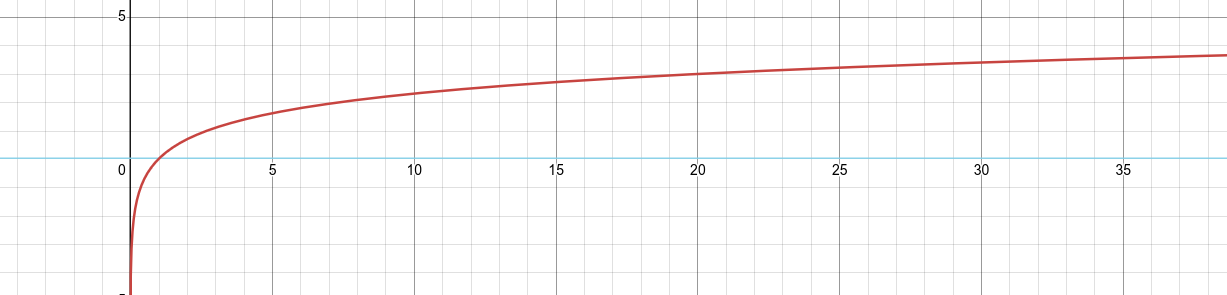
Le logarithme népérien est le logarithme en base e e e ln ( x ) \ln(x) ln ( x ) x > 0 x > 0 x > 0 ln ( e x ) = x \ln(e^x) = x ln ( e x ) = x x > 0 x > 0 x > 0 ln ( x ) > 0 \ln(x) > 0 ln ( x ) > 0
ln ( 1 ) = 0 \ln(1) = 0 ln ( 1 ) = 0 ln ( e ) = 1 \ln(e) = 1 ln ( e ) = 1 ln ( 1 x ) = − ln ( x ) \ln(\frac{1}{x}) = -\ln(x) ln ( x 1 ) = − ln ( x ) ln ( x y ) = ln ( x ) − ln ( y ) \ln(\frac{x}{y}) = \ln(x) - \ln(y) ln ( y x ) = ln ( x ) − ln ( y ) ln ( x ) n = n ln ( x ) \ln(x)^n = n\ln(x) ln ( x ) n = n ln ( x ) ln ( x ) = 1 2 ln ( x ) \ln(\sqrt{x}) = \frac{1}{2}\ln(x) ln ( x ) = 2 1 ln ( x )
Exemple : Simplifier les expressions suivantes:
A = l n ( 3 − ( 5 ) ) + l n ( 3 + ( 5 ) ) A = ln(3 - \sqrt(5)) + ln(3 + \sqrt(5)) A = l n ( 3 − ( 5 )) + l n ( 3 + ( 5 )) A = l n ( ( 3 − ( 5 ) ) ( 3 + ( 5 ) ) ) A = ln((3 - \sqrt(5))(3 + \sqrt(5))) A = l n (( 3 − ( 5 )) ( 3 + ( 5 ))) A = l n ( 9 − 5 ) A = ln(9 - 5) A = l n ( 9 − 5 ) A = l n ( 4 ) A = ln(4) A = l n ( 4 ) Dérivation
La dérivée du logarithme népérien est donnée par la formule suivante:
ln ( x ) = 1 x \ln(x) = \frac{1}{x} ln ( x ) = x 1 Exemple : Calculer la dérivée de la fonction f ( x ) = ln ( 1 − 2 x + x 2 ) f(x) = \ln(1 - 2x + x^2) f ( x ) = ln ( 1 − 2 x + x 2 )
u = 1 − 2 x + x 2 u = 1 - 2x + x^2 u = 1 − 2 x + x 2 u ′ = − 2 + 2 x u' = -2 + 2x u ′ = − 2 + 2 x f ′ ( x ) = u ′ u = − 2 + 2 x 1 − 2 x + x 2 f'(x) = \frac{u'}{u} = \frac{-2 + 2x}{1 - 2x + x^2} f ′ ( x ) = u u ′ = 1 − 2 x + x 2 − 2 + 2 x